Decision Intelligence: Using AI to Make Smarter Business Choices
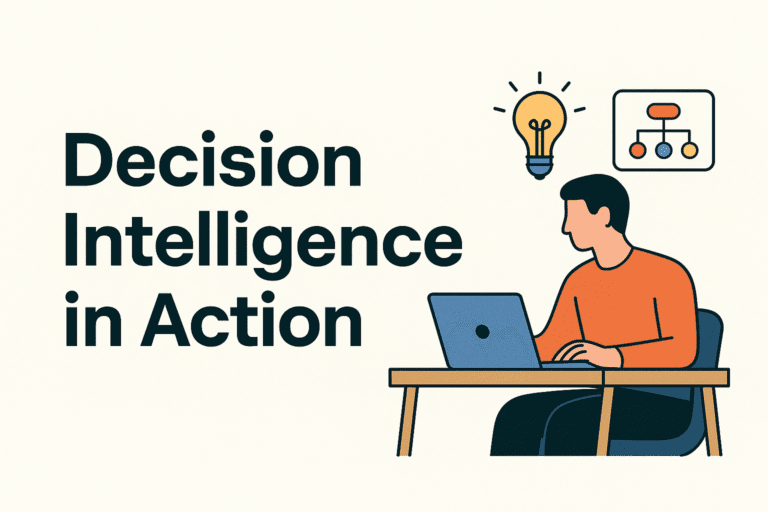
Imagine sitting in a boardroom, surrounded by dashboards full of numbers. Sales trends, customer behavior, supply chain delays—it’s all there. Yet the big question remains: What should we do next?
This is where Decision Intelligence steps in. It’s not just about analyzing data. It’s about using AI to guide smarter, faster, and more confident choices.
What Exactly Is Decision Intelligence?
At its core, Decision Intelligence (DI) is the fusion of AI, data analytics, and human judgment. Think of it as a bridge between raw data and real-world action.
Instead of drowning in spreadsheets, DI translates insights into recommendations. It doesn’t replace leaders—it equips them with clarity.
Why 2025 Is the Year of Smarter Decisions
Businesses today face overwhelming complexity. Global supply chains, unpredictable markets, and customer expectations that change overnight. Traditional decision-making can’t keep up.
In 2025, AI systems are evolving beyond simple predictions. They’re simulating possible outcomes, weighing trade-offs, and even suggesting optimal paths forward.
For example, a retailer can test whether lowering prices in one region boosts profits overall—or risks hurting brand perception. That’s DI in action.
Real-World Applications
- Marketing: Predict which campaign will resonate most before spending a single dollar.
- Finance: Balance investment risk with real-time economic signals.
- Healthcare: Optimize treatment plans by analyzing thousands of patient outcomes.
- Supply Chain: Reroute deliveries instantly when a disruption occurs.
These are not just “nice to have” scenarios. They’re survival strategies in a hyper-competitive market.
The Human + AI Equation
One myth is that DI hands over full control to machines. In reality, it thrives on human-AI collaboration.
Humans bring context, empathy, and ethical judgment. AI brings scale, speed, and the ability to process patterns we’d never see. Together, they create decisions that are not only smarter but also more responsible.
The Challenges We Can’t Ignore
No technology is without risks. Poor data can lead to poor decisions. Hidden bias in algorithms can create unfair outcomes. And over-reliance on AI may discourage critical thinking.
That’s why transparency and ethical frameworks are just as important as the technology itself.
Closing Reflection
In a world overflowing with choices, Decision Intelligence is becoming the compass businesses can’t afford to ignore. It doesn’t promise perfection, but it offers a sharper, faster, and more confident way forward.
The real question is: When faced with your next big decision, will you trust instinct alone—or invite AI into the room?