The Complete AI Engineering Roadmap for Beginners
A few years ago, I thought AI engineering was something only geniuses at Google could do. You know—the kind of people who casually talk about neural networks over coffee.
But today, things are different. The tools are open. The knowledge is free. And if you’re reading this, you already have everything you need to start your journey.
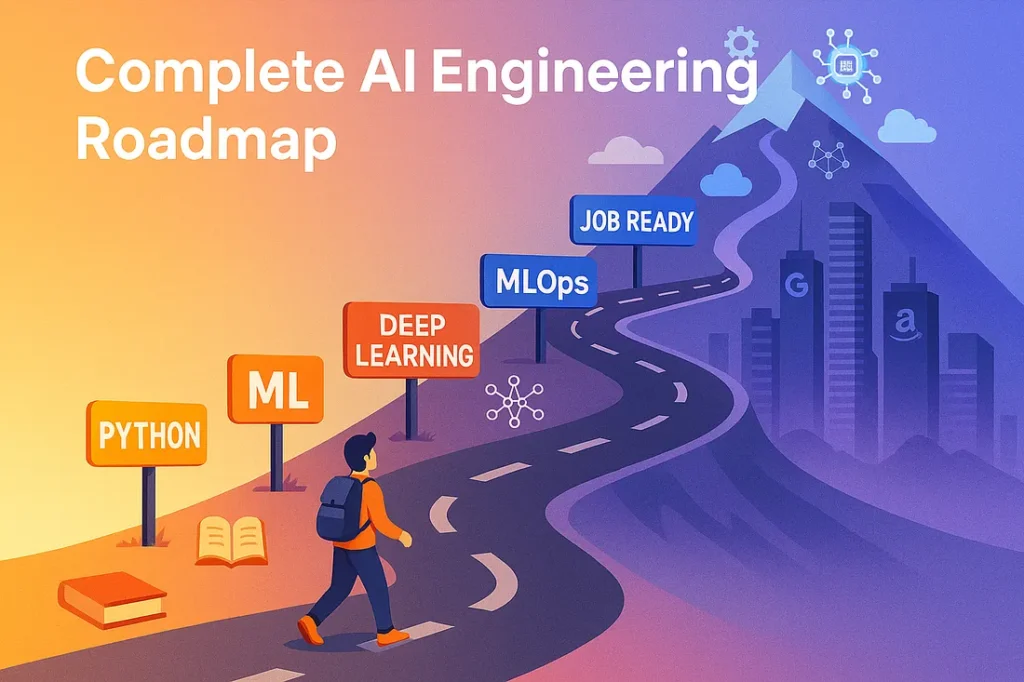
This is your complete roadmap to becoming an AI Engineer—even if you’re starting from zero.
Step 1: Learn the language of machines
Before diving into AI, you need to speak its language—Python.
Python isn’t just popular because it’s simple; it’s powerful because it has the richest ecosystem for AI and data work.
Start small. Build a calculator. Create a to-do app. Learn about data types, loops, and functions.
Then move on to libraries like NumPy, Pandas, and Matplotlib—they’ll teach you how to clean, manipulate, and visualize data.
Remember: being great at Python doesn’t mean writing fancy code. It means writing code that makes sense to both humans and machines.
Step 2: Master the math that matters
Here’s the truth: you don’t need a PhD in mathematics to work in AI.
But you do need to understand the basics of:
- Linear Algebra (vectors, matrices, dot products)
- Probability & Statistics (mean, variance, distributions)
- Calculus (light version) — mostly derivatives and gradients
Why? Because these are the gears turning inside every machine learning algorithm.
When you grasp these fundamentals, models stop feeling like “magic” and start feeling like logic.
Step 3: Learn Machine Learning
Now comes the fun part—teaching machines to learn.
Start with supervised learning (classification and regression). Play with datasets like predicting house prices or recognizing handwritten digits.
Use tools like scikit-learn—they simplify the hard math into clean, readable code.
Once you get the hang of that, explore unsupervised learning (clustering, dimensionality reduction) and reinforcement learning (teaching agents to make decisions).
The key here isn’t to memorize algorithms—it’s to understand what problem each one solves.
Step 4: Deep dive into Deep Learning
Machine Learning is the foundation; Deep Learning is the skyscraper built on top.
Here’s where frameworks like TensorFlow and PyTorch come in. They let you build neural networks that can recognize images, generate text, or even write music.
Start with simple models:
- A neural network that predicts numbers
- A CNN (Convolutional Neural Network) that recognizes objects in photos
- An RNN or Transformer that generates text
The “aha” moment comes when your model starts producing results that feel… human.
Step 5: Understand AI Systems & MLOps
Most beginners stop after building models. But real AI engineers go further—they deploy them.
Learn how to:
- Serve models using FastAPI or Flask
- Use Docker to containerize your app
- Automate workflows with CI/CD pipelines
- Monitor performance and retrain models using MLOps tools like MLflow or Kubeflow
This is where AI meets the real world. Companies don’t want experiments—they want systems that work reliably and scale.
Step 6: Build projects that matter
Don’t just learn—build.
Start with small but meaningful projects:
- A movie recommender system
- A chatbot using OpenAI or Llama APIs
- A document summarizer for your own notes
- A personal voice assistant powered by speech recognition
Every project you complete becomes a story—something you can show, share, and be proud of.
And trust me, a portfolio beats any certificate.
Step 7: Join the AI community
AI is a team sport.
Join Discord servers, follow AI engineers on X (Twitter), contribute to open-source projects, or share your experiments on GitHub.
Every conversation is a chance to learn. Every connection is a door to opportunity.
The more you collaborate, the faster you’ll grow.
Conclusion: The real secret to becoming an AI Engineer
The roadmap is clear. But here’s the secret no one tells you: you don’t have to learn it all at once.
AI is a vast ocean. Don’t try to swim the whole thing—just start paddling. Build momentum, stay curious, and celebrate every small win.
Because AI engineering isn’t just about coding intelligence into machines—it’s about unlocking intelligence within yourself.
So here’s the question I’ll leave you with:
👉 Will you just watch the AI revolution happen—or will you help build it?