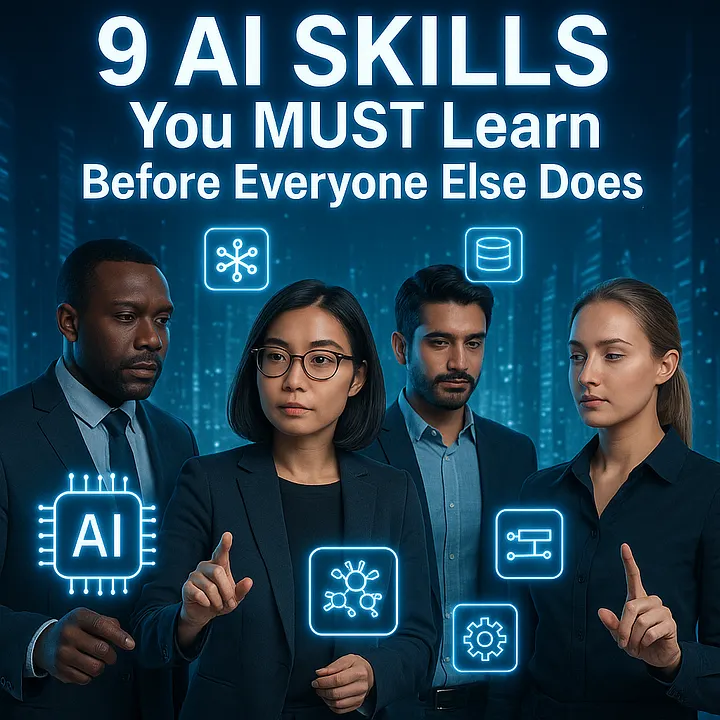
9 AI Skills You MUST Learn Before Everyone Else Does (or Get Left Behind)
Not long ago, knowing how to use Excel or PowerPoint could land you a decent job.
Today, that’s not enough.
We’re living in a world where the people who understand AI tools, automation, and data are sprinting ahead — and everyone else is struggling to keep up.
If you want to future-proof your career (and maybe even leapfrog into something better), here are the 9 AI skills you need to learn now — before they become as common as “basic computer literacy.”
1. Prompt Engineering: The Art of Talking to Machines
Let’s start with the obvious — because it’s not just about “using ChatGPT.”
Prompt engineering is the new literacy. It’s about getting AI to do exactly what you want, from writing sales emails to designing marketing campaigns to debugging code.
Think of it like learning how to ask the right question, not just any question.
Those who master this skill are already 10x more productive than their peers.
🧠 Pro tip: Practice by turning vague prompts into detailed instructions — and compare the results. That’s how pros train.
2. Workflow Automation
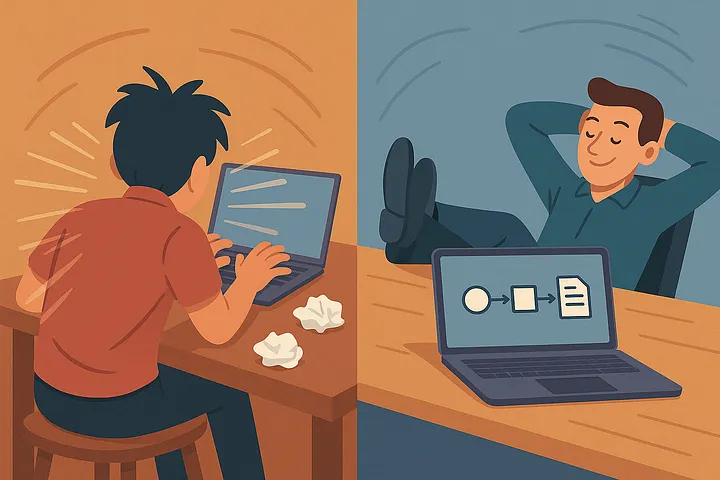
If you’re still doing repetitive tasks manually, you’re falling behind.
Tools like n8n, Zapier, and Make.com let you connect AI models with your daily apps — automating reports, emails, content creation, and customer interactions.
One solopreneur I met now runs a newsletter with zero manual effort. AI writes, edits, and publishes it. He just reviews the final version.
Automation is the bridge between “knowing AI” and using it to scale your time.
3. Data Literacy
You don’t need to be a data scientist. But you do need to understand data.
Knowing how to clean, interpret, and visualize information using Python, Pandas, or even Google Sheets can make you invaluable.
AI tools rely on clean, structured data. If you can prepare that — you’re already part of the AI economy.
4. AI Tool Mastery
AI tools are like muscles — the more you use them, the stronger your results.
Learn the major players in your field. For instance:
- Midjourney / Leonardo AI for creatives.
- ChatGPT / Claude / Gemini for writing and research.
- Runway / Pika Labs for video.
- Perplexity / Elicit for learning and research.
The goal isn’t to use them all — it’s to find the 2 or 3 that supercharge your workflow.
5. Basic Coding with AI
You don’t need to become a full-stack developer — but a little coding goes a long way.
Learn how to use Python or JavaScript with AI APIs. You’ll be able to build simple tools, automate data processing, or even launch your own AI-based product.
With ChatGPT’s code interpreter or tools like Replit and Cursor, coding is more like collaborating with a super smart assistant.
6. AI Ethics & Policy
Here’s a less glamorous — but increasingly vital — skill.
Companies need people who understand privacy, bias, copyright, and regulation in AI. If you can explain how to use AI responsibly, you become a voice of trust in a chaotic space.
This is especially critical for educators, marketers, HR leaders, and legal professionals.
7. Model Customization (Fine-Tuning & Embeddings)
The next frontier isn’t using ChatGPT — it’s training your own version of it.
Fine-tuning and embeddings allow you to create domain-specific chatbots that know your data — your business, your customers, your tone.
Imagine building an AI assistant that writes like you, speaks your brand language, and answers questions about your company.
That’s where the serious money is going.
8. AI-Driven Decision-Making
Executives used to rely on intuition. Now, they rely on dashboards powered by AI predictions.
Learning how to interpret insights from machine learning models — or use tools like Power BI, Tableau, or ChatGPT Advanced Data Analysis — will help you make faster, smarter decisions. The future isn’t about guessing. It’s about reading the data before it hits the news
9. Creativity & Critical Thinking
Here’s the paradox: as AI gets smarter, human creativity becomes more valuable.
AI can remix ideas, but it can’t dream like you do.
The people who thrive will be those who combine creative imagination with technical precision.
So don’t just learn to use AI — learn to play with it. Experiment. Build. Break things. That’s how innovation happens.
Final Reflection
AI isn’t coming for your job — it’s coming for your skill gaps.
If you fill them first, you win. If you don’t, someone else will.
The real opportunity isn’t in resisting AI — it’s in mastering it faster than everyone else around you.
So here’s my question:
👉 Which of these 9 AI skills will you commit to mastering this month?
Because the future won’t wait — but it will reward those who start early.