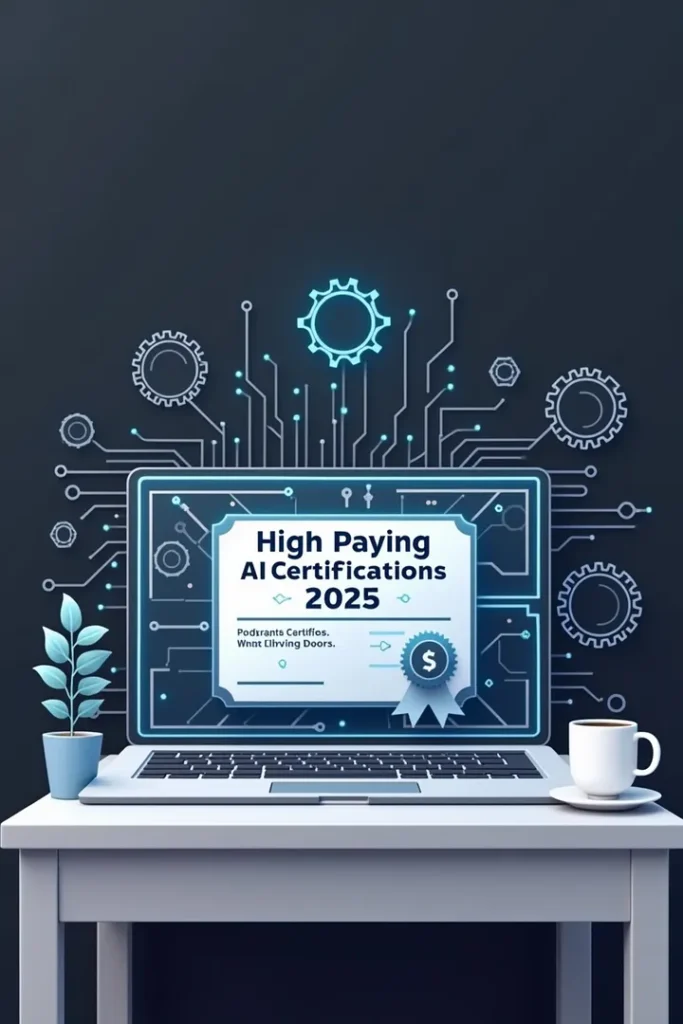
High-Paying AI Certifications 2025: 5 Programs That Open Doors
The Moment I Realized a Certificate Could Change Everything
A few years back, I was talking to my friend Sara, who worked as a data analyst in a midsize company. She shared a frustration: no matter how much she learned on her own, recruiters would still ask, “Do you have a certification?”
Then she invested in a well-known AI certificate. Six months later, she got a job offer with a 40 % raise. That moment stuck with me: a good certification can act as both validation and a door opener.
In 2025, where AI is everywhere, the right certification could be the difference between being another resume in the stack and standing out.
What Makes an AI Certification “High-Paying”?
Not all certificates are equal. Here’s what separates ones that pay from ones that look pretty.
- Industry recognition. If employers and teams already trust the issuing institution, your certificate carries weight.
- Hands-on projects. The more you build models or systems yourself, the more you internalize—and the more proof you have.
- Clear alignment with roles. If the certificate prepares you for roles like AI engineer, ML ops, or prompt engineering, it’s more likely to convert to salary.
- Up-to-date curriculum. AI changes fast. Certifications that persist with new trends (e.g. generative models, LLMs) are more valuable.
- Support / network. Coaching, mentorship, community—these can be what pushes you over the edge when applying or interviewing.
With that in mind, let’s look at five AI certifications (or programs) in 2025 that meet many of these criteria.
1. Stanford University AI Graduate Certificate
This is more than an online course—it’s a university-backed credential that carries weight. It goes deep into AI theory, machine learning, natural language processing, and more. (TechTarget)
Why it’s powerful: you get access to Stanford professors, rigorous courses, and brand recognition. For roles in research, enterprise AI, or academia, this adds serious credibility.
Challenge: It’s not cheap, and it demands serious commitment (math and programming background expected). But if you complete it, you don’t just get a certificate—you get a signal of mastery.
2. MIT Professional Certificate in Machine Learning & Artificial Intelligence
MIT’s professional education arm offers a robust program aimed at working professionals who want applied knowledge. (professional.mit.edu)
What’s good here: MIT’s name helps open doors. The program balances theory and practice. If you’re in a technical role now and want to level up, this is a great bet.
Consideration: Some parts might be abstract. Always check whether there’s a capstone or project component before you commit.
3. DataCamp / Industry-Focused AI Certifications
DataCamp offers a mix of AI-focused credentials, such as the AI Fundamentals Certification and more advanced tracks for AI Engineers. (DataCamp)
Why it matters: These are more accessible—easier entry points—and you can progress in steps. For someone transitioning, this is low-risk.
But: Because many people can get them, you’ll differentiate more by your project work and portfolio than by the certificate name alone.
4. NVIDIA Deep Learning Institute (DLI) Certifications
If your interest lies in deep learning, computer vision, or GPU-accelerated AI, NVIDIA’s DLI courses offer strong credibility. (arXiv)
What stands out: You not only learn the models, but you also get practical experience with hardware — training on GPUs, optimizing performance, understanding parallel computing.
Limitation: It’s narrower in scope. It won’t substitute for a broader AI theory certificate if you want flexibility.
5. Generative AI & Prompt Engineering Certifications (Coursera / DeepLearning.AI / Google)
In 2025, generative AI is no longer fringe—it’s central. Certificates around prompt engineering, building AI agents, and LLM applications offer real utility. (Coursera)
These often come as specializations or professional certificates from top platforms. Because the field is new, a well-designed certificate here shows you are ready for tomorrow’s roles—not yesterday’s.
Caveat: Because the space is fast-moving, you’ll want to make sure the certificate stays updated and teaches future-facing skills.
How to Choose (and Maximize) One for You
Here’s a playbook to pick well:
- Match it to your target role. Do you want ML ops, prompt engineering, AI policy? Choose a certificate that aligns.
- Look at sample projects. If past students built production-ready models or applications, that’s a good sign.
- Check for mentorship or feedback. A certificate alone doesn’t teach you soft skills—mentors do.
- Use it for portfolio, not just credential. Show the work, share it publicly.
- Continuously update your knowledge. A certificate in 2025 doesn’t immunize you—keep learning after you finish.
A Real-World Turnaround: How One Engineer Switched to Generative AI
Meet Omar, an embedded systems engineer for years. He loved hardware, but his salary growth plateaued. He noticed generative AI exploding, and decided to pivot.
He enrolled in a generative AI specialization, learned prompt engineering, and built a few small agent prototypes. He shared them on GitHub and Twitter. Six months later, a startup reached out and hired him as an AI tools engineer—with a salary 50 % higher than before.
His certification wasn’t magic—but it was the spark that lit the path.
Conclusion: Your Certification Is Only the Start
A high-paying AI certification doesn’t guarantee a dream job—but it can open doors you didn’t know existed. It’s a signal. A push. A confidence builder.
Choose smart. Build skill. Show work. Keep evolving.
Reflection: Which of these five certifications resonated most with your goals—and what first project would you build to prove your value?