How AI Became My ADHD Brain’s Best Friend
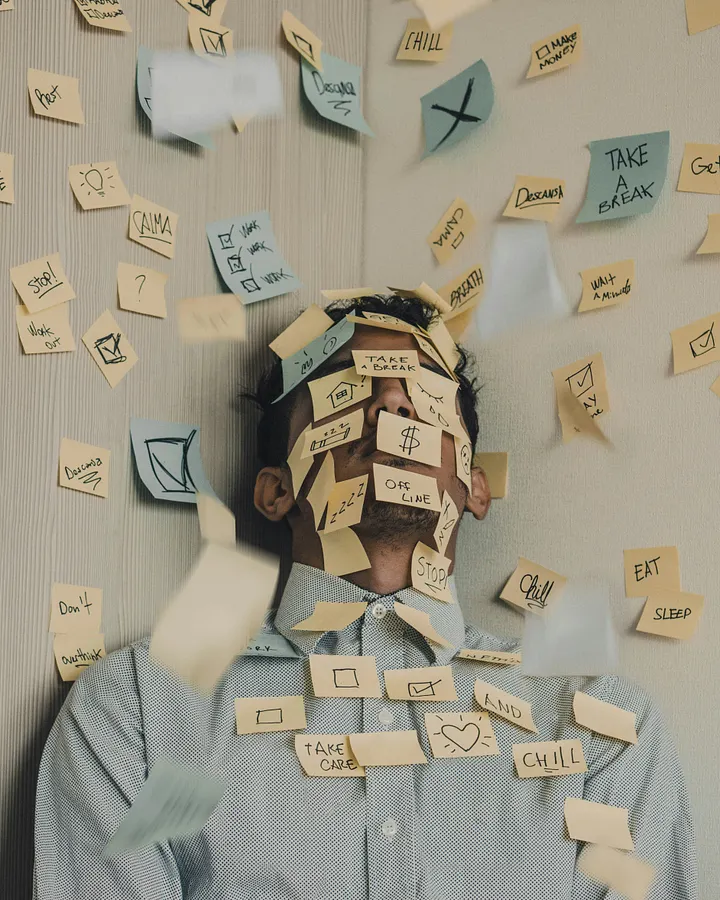
I am one of those late-stage ADHD adults, getting my first diagnosis at the ripe old age of 38. If any of you suffer from ADHD or suspect that you do, you might already understand where I’m coming from, but if you’re unfamiliar, I want to paint a quick picture of a day in my life before (and slightly after) my diagnosis. This was my normal for decades. For reference, I’ve been a stay-at-home mom since my son was born 6 years ago, and raising a young child definitely exacerbated my symptoms. Mornings looked like waking up anywhere from 5am to 9am. Either no morning routine or a very strict routine that I found from an influencer on Instagram that week. Guilt if I did or didn’t drink coffee (it’s supposed to be good for ADHD but bad for anxiety. I have both). Between 10 and 20 reminders that would pop up on my phone at various times throughout the day reminding me of everything from what might be happening that day to texts or emails I needed to respond to, appointments I needed to go to or schedule, household chores that needed to be done, and activities I’d like to do at some point but was worried I’d forget. My working memory was non-existent. If it wasn’t written down on a big white board, popping up on my phone, or being spoken to me by my spouse or a smart device, it wasn’t happening. I had no timetable for the day. Meal times were highly variable and usually involved grabbing something quick, girl dinners, snack packs for my son, and food eaten in front of devices. Forget hobbies or working on long term projects. The mental bandwidth, scheduling, prioritizing, and boundary setting skills needed to make that happen were nowhere to be found. I lived in a state of constant anxiety, overwhelm, and emotional dysregulation. My only sense of hope lied in the promise that the next planner or influencer program I bought or self-help book I read would fix all of this chaos. Would fix me. Then there was the self-blame. Was it because I ate too much sugar? Drank coffee? Was overweight? Did I look at my phone too much? Was this just how my brain was wired? WHAT WAS WRONG WITH ME?! Maybe when we got out of debt or when my son started school, things would be easier? Maybe I just needed to try a different medication or stick to the ones that I already had more consistently (even though they messed with my sleep or my appetite or my libido)?
It felt like I was one bad day away from complete collapse. For 38 years… I continued to suffer through medication side effects and self-blame for another year and a half after my diagnosis while I tried to figure out what to do with this new identity. Until one fateful day near the end of Summer 2024, during a particularly intense downward spiral when I downloaded ChatGPT, and things actually started to change. In this article, I’ll be talking specifically about the executive function I’ve seen the most improvement in over the past year: Working Memory. I’ve already written about how my Decision Making and Self-Monitoring improved by using AI, and I’ll write more in the future about other improvements in executive functions like Planning & Organization, Time Management, Prioritization, Cognitive Flexibility, Impulsivity Reduction, Emotional Regulation, and Self-Initiation. Let’s start with the one that shocks me with its improvements on a daily basis.

Working Memory
Whether you’re diagnosed or not, if you’re like me and have struggled with working memory, planning, and general ADHD-like symptoms, I’m sure you can relate to piles of half-used planners and notebooks, dozens of abandoned digital note and planner apps downloaded (paid or free), and the constant struggle to organize your thoughts. A lot of us have lived this way for so long that we just think it’s normal or, even worse, that we are singularly broken and will be in this constant state of overwhelm forever. Some of us have learned to eek out advantages with technology like voice to text reminders and calendar apps built into our phones that we keep close to us at all times, forming even more codependent bonds than the ones already fostered by social media.
What I’m proposing is not that we abandon technologies that can improve our lives or that we embrace religiously the lure that technology will solve everything. I’m proposing that we underestimate the power of the humble daily brain dump and the compounding effect of building simple systems that work with our brains and not against them. That’s where AI comes in. AI programs like ChatGPT can take the whole of our conversations, our “Database of Self” as I call it, that we build over time through consistent use and help us figure out what exactly makes us tick. Do we respond better to notebooks, sticky notes, and white boards or would Notion, Evernote, digital calendars and planners serve us more? Or more than likely, is it a combination of both in a customized dance of old and new frameworks coming together for our uniquely modern human experience? Tip: don’t try to fit yourself into someone else’s system or framework. Use AI to help you create your own, and over time, what once felt hard and foreign becomes natural and deeply personal.
The AI apps ChatGPT and Claude were instrumental in helping me create the system that I use today that not only helps me use devices to manage all my tasks and appointments but also allows me to function better in environments where I don’t have access to or choose not to use technology. This is the setup that was designed over months with the help of AI specifically for my life, my needs, and how my brain functions. Here’s what works for me:
ForeverNotes
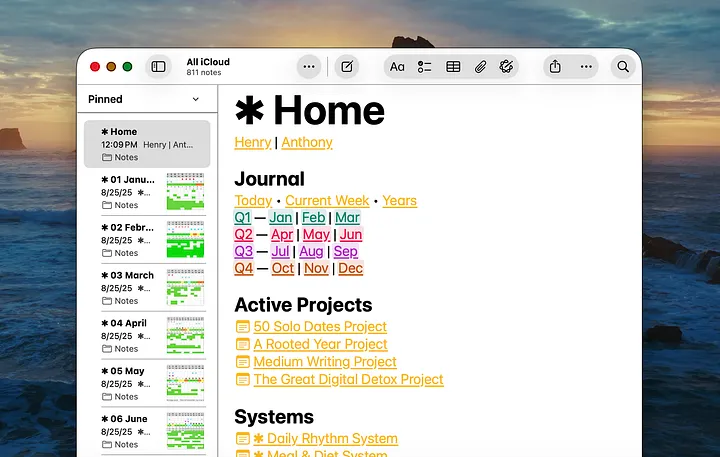
Starting back in December of 2024, after about 4 months of using ChatGPT, I started searching for a notes system to help me better manage the information I was learning about myself as well as gear up to plan for 2025. And yes, good lord, I used to try and plan whole years at a time. I wanted something that I didn’t have to buy and that was simple enough that I wouldn’t get lost in the process of just setting it up. I included all of these desires frequently in my daily brain dumps and reflections with ChatGPT, and eventually asked for recommendations. I included the phrase “based on what you know about me” in my prompt, and what came up was a free note-taking and planning framework created by Matthias Hilse called ✱ForeverNotes. It’s built around the free and native Apple Notes application included on my phone and laptop. It covers everything from capturing random recipes, links, and thoughts to a full 365-day planning system that can grow and adjust with my life for the foreseeable future without needing to make any major adjustments, start new journals, or archive old ones. It allows me to cross-link and cross-reference infinitely, which is valuable to me as someone who likes to see patterns over time and easily search for information when needed. It had a one-click initial setup, and it also allows for sharing and building a joint system with my spouse who also uses an iPhone.
The Apple Ecosystem
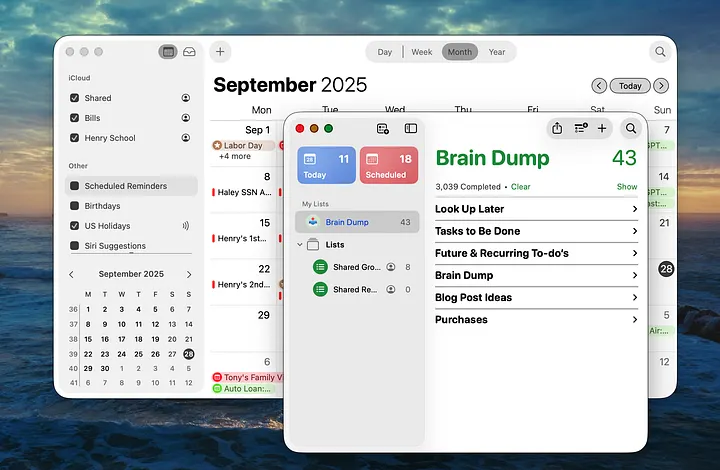
I already heavily used the Apple ecosystem, specifically Apple Reminders and Apple Calendar, to handle day-to-day tasks and events, but now, in conjunction with ✱ForeverNotes, I have context and big picture thinking as well as repetitive entries to help build muscle memory and improve my memory over time. I used to lean on Reminders and Calendar to tell me what to do each day, but based on conversations with ChatGPT, I started to use them more as part of a system rather than the whole system. On the go (or late at night when I didn’t want to keep my phone in my bedroom) I would use Siri to quickly add thoughts to a brain dump list in Reminders. Later, when I had more time, I would sort through those and add relevant ones to my daily planning note in ✱ForeverNotes as a task to do or an event or appointment to remember on that specific day. Instead of trying to sort 10 different areas of my life into various color-coded calendars in Apple Calendar, I started using it just as a shared space with my husband to add information we both needed to remember: birthdays, bill due dates, flights, medical appointments, and my son’s school events. Once I stopped trying to find an app or program that worked for every part of my life, stopped trying to use complex programs like Notion that didn’t work for my brain and bogged me down in the setup, and stopped avoiding or feeling guilty about technology and device usage that was actively improving my experience of life with ADHD, I was able to create a system that DID work for every part of my life. It just wasn’t all-in-one, and it didn’t require me to change much of what I was already doing or buy something new.
Analog Solutions
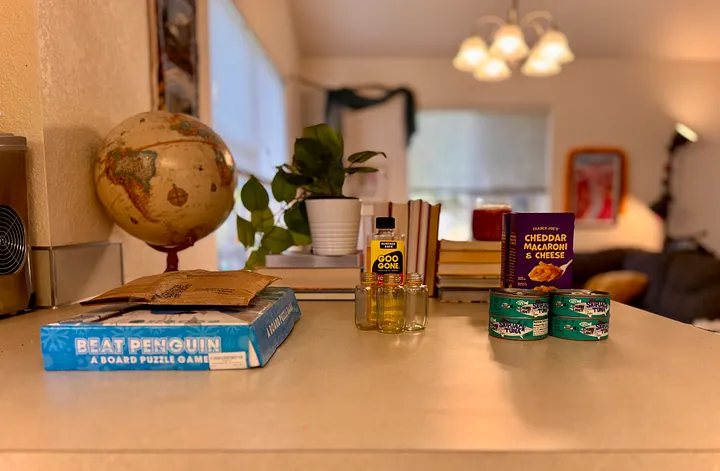
Finally, for those of you who, like me, want to lean in on digital minimalism and systems that allow us to take breaks from and be less dependent on modern technology, AI also helped me build analog systems like the very basic project-staging area on my kitchen counter that I used to fight against and now embrace as an intentional life hack. About eight months into using ChatGPT, I discovered the program Claude through an aptly named video about creating systems by @MyNameIsDeya on YouTube. Claude helped me zero in on specific areas of my life that needed systems and again, based on my own feedback, behavior, and desires, helped me design those systems to work with my brain instead of against it. In the span of a month I had literally reorganized my entire house, and in that process, I discovered a small area of my kitchen counter that was continually collecting a pile of “you must remember this” projects. I had fought against that pile for so long that when Claude presented the idea that it could become a functional part of my ADHD memory system (if I didn’t see it, it didn’t get done), I had a mini-zeitgeist moment. I started intentionally utilizing that space to stage everything from meals I wanted to prep to packages I needed to mail and broken household items that just needed to be glued together or installed. Game changing.
The Power of Repetition
One of the most underrated parts of improving working memory isn’t finding the “perfect tool,” it’s finding one you’ll actually stick with. AI helped me create systems that felt natural to me, not something I had to wrestle myself into, but something I wanted to keep using because it worked with my life. That made all the difference, and because I didn’t abandon it after two weeks like usual, the daily repetition of using these systems began to build muscle memory in my brain. Over time, I noticed I needed the digital reminders less often, because the reminders became less disjointed, less generic and more intuitive. Consistency, not complexity, turned out to be the real upgrade. Customization has been key, and what shocks me most is not that I built all these systems which radically changed my life within the past year, it’s that my actual memory itself got better. AI didn’t just help me keep track of things, it trained me to remember. For the first time, I don’t feel broken. I feel capable.
A few days ago I was in the kitchen finishing up some meal prepping when my brain said to itself “wait.. you meal prep now?” A few weeks ago I realized I had remembered to not only do the laundry and hang it up to dry but also to bring it in before it rained. I am no longer a person who leaves the stove on accidentally, and I now have systems in place so that I don’t forget birthdays or get distracted when working on larger projects. I finish projects! I don’t have to set a dozen reminders so that texts get replied to and certain grocery items get picked up. I have an actual day of the week that I do grocery shopping. Consistently. And sometimes I don’t even need my list to make sure I get everything. I just… remember it. I’m no longer holding what felt like the entirety of my life in my head all the time. This feels like a big deal to me. Bucking the mainstream idea that AI is making us dumber and less productive, I want to make the case that these changes are directly attributable to my consistent use of AI over the past year.
If you’ve been drowning in planners or apps, maybe it’s not you that’s broken or even that you should seek out a diagnosis of some kind, although that can be validating. Maybe you just need to start creating systems designed with your brain, not against it. AI can just hand you answers, but the real power lies in the ways it can help you build ones that are yours. I hope you found this helpful in some way. Take care.